
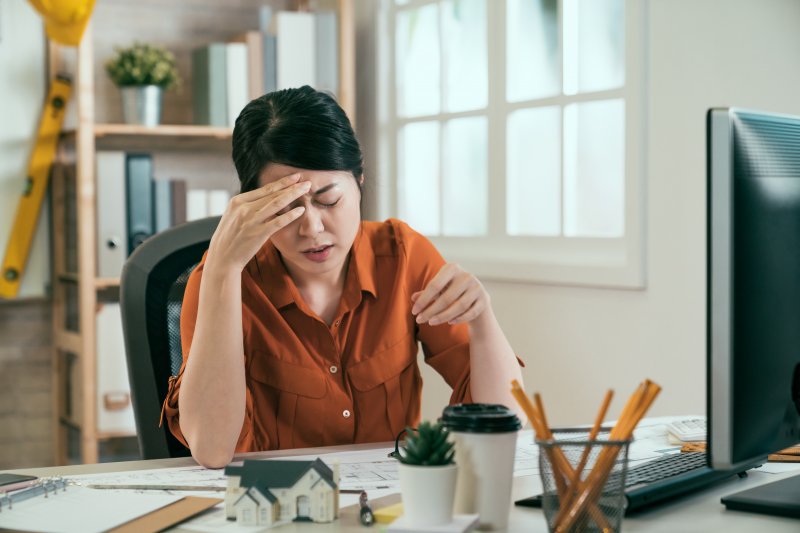
TMJ disorders are well-known for causing achy jaws and chewing troubles, but those aren’t the only symptoms worth noting. Issues with your temporomandibular joints can also cause serious head pain. With all that said, you might wonder: What do these “TMJ headaches” feel like? Your Catonsville dentist is here with a detailed answer for you. So, please keep reading to learn the sensations of TMJ headaches and how you can manage them better.
TMJ Disorders Can Cause Headaches
While people rightly view TMJ disorders as a source of pain, their discomfort isn’t limited to jaw joints. Pain from them can easily take the form of headaches.
Your TMJs – your temporomandibular joints – share a direct connection with your head. Various muscles around them act as a “bridge” between your jaw, cheeks, and the sides of your cranium. As a result, problems with your jaw joints (or the connecting muscles) can put stress on your head and cause headaches. An uneven bite or a tendency to clench your teeth adds to such pressure.
Notably, many mistake a “TMJ headache” for tension or migraine headaches. One study found that head pain caused by TMJ was misdiagnosed as a tension headache in 31% of research respondents.
What Do TMJ Headaches Feel Like?
Due to how they’re caused, TMJ headaches give off distinct sensations. You can often tell you have one from the feelings it prompts.
What a TMJ headache “feels like” is rather complex at times. In most cases, it leads to a sense of pressure in one or more regions of the head. It can also leave you with a feeling that your bite has changed. If the headache is rather bad, its pain can also feel worse when you chew, yawn, or move your jaw.
When the above describes your aching head, see your dentist or another TMJ professional quickly. They can fully confirm whether you have a full-blown TMJ disorder.
Tips on Managing TMJ Headaches
Once you’ve confirmed you have a TMJ headache, you can take various steps to manage it. These include the following:
- Avoid Certain Foods – Often, biting hard or chewy foods causes jaw movements that trigger TMJ headaches. You can thus reduce your aches by avoiding such items.
- Stretch & Massage – Another idea is to stretch and massage the muscles connecting your TMJ and head. By doing so, you’d make TMJ headaches less painful and likely.
- Get Proper Treatment – If you want a lasting solution, see your local dentist for targeted TMJ therapy. They can provide you with an occlusal splint or equivalent procedures.
When you know what TMJ headaches feel like, you’re one step closer to getting past them. So, make sure to remember the details and tips above!
About the Practice
Advance Dental Clinic is based in Catonsville, MD. Led by Dr. Maryam Bemani, our practice seeks to provide personalized dentistry for every patient. We thus include your feedback in the treatment process, whether you’re getting preventive, cosmetic, or restorative care. The result is that your smile receives the unique and tailored help it deserves! For more details or to book a visit, please contact us on our website or by phone at (443)-251-5580.